


By Dr. Joseph King | King LASIK
Dr. King is an ophthalmologist at King LASIK, serving patients in Seattle, Portland, Tacoma, Olympia, Tri-Cities, Everett, Vancouver, and the Scottsdale/Phoenix area.
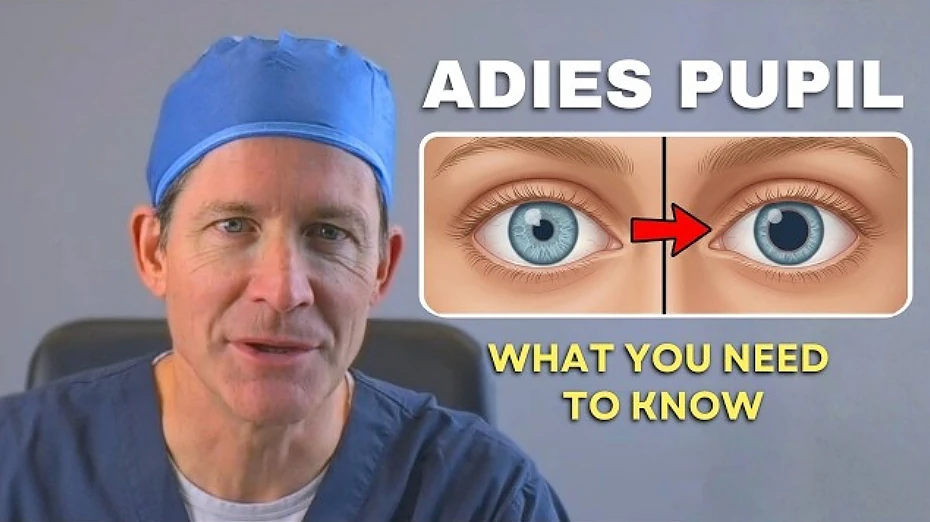
If you have noticed that one of your pupils looks noticeably larger than the other, or that your eye seems slow to respond to bright light, it can be unsettling. For many people, the culprit turns out to be a condition called Adie’s pupil, a neurological disorder that sounds intimidating but is typically benign and very manageable.
Watch our overview, then read on to understand what is happening and what you can do about it.
What Is Adie’s Pupil?
Adie’s pupil is a neurological condition that affects the autonomic nervous system, the network of nerves controlling automatic body functions like blinking, sweating, and how your pupils respond to light.
Normally, your pupils constrict in bright light to protect your retina and dilate in dim conditions to let in more light. Think of it like an automatic camera aperture adjusting in real time. With Adie’s pupil, that automatic adjustment system becomes impaired. The affected pupil, usually in just one eye, becomes larger than normal and does not respond properly to bright light. Instead of constricting quickly, it responds very slowly or barely at all.
What Causes It?
The honest answer is that we do not know for certain. Tiny nerves called ciliary nerves control the muscles in your iris that regulate pupil size. In Adie’s pupil, those nerves become damaged or stop functioning properly.
Most specialists believe this nerve damage is often triggered by a viral or bacterial infection. You may not even remember being sick, but your immune response may have affected these delicate nerve pathways. An autoimmune process, where the immune system mistakenly attacks healthy tissue, is another theory.
The important thing to understand is that Adie’s pupil is typically not a sign of a serious brain condition or tumor. It is usually an isolated problem with these specific nerves, not part of a broader neurological disease. That said, a proper evaluation is essential to rule out other causes.
What Are the Symptoms?
The most obvious sign is pupil asymmetry. One pupil appears noticeably larger than the other, particularly in bright light, sometimes by 2 to 3 millimeters. Many patients notice this in the mirror, or a family member points it out first.
Beyond the appearance, Adie’s pupil can affect vision and comfort in a few ways:
- Light sensitivity: Because the pupil cannot constrict properly, bright environments become uncomfortable. Stepping outside on a sunny day or even sitting under standard indoor lighting can feel overwhelming.
- Difficulty with near focus: The same nerves that control pupil size also help the eye focus on close objects. When they are damaged, reading, screen use, and detailed tasks become harder. Many patients find themselves holding books or phones further away than usual.
- Reduced reflexes: In some cases, the nerve dysfunction also affects reflexes elsewhere in the body, such as the knee-jerk reflex.
- Excessive sweating: Autonomic nervous system involvement can occasionally cause sweating unrelated to temperature or activity.
In rare cases, less than 20% of patients, both eyes are affected.
How Is It Diagnosed?
Adie’s pupil can usually be identified during a comprehensive eye exam. Our team observes how each pupil responds under different lighting conditions and uses a penlight to assess the speed and degree of constriction.
One of the most definitive diagnostic tools involves a dilute concentration of pilocarpine eye drops. In a normal eye, these drops have minimal effect. In an eye with Adie’s pupil, the damaged nerves become hypersensitive to certain chemicals, causing the abnormal pupil to constrict noticeably. A slit lamp exam, which magnifies and illuminates the eye’s internal structures, may also reveal subtle signs of nerve involvement.
In some cases, we may refer patients to a neurologist to confirm the diagnosis and rule out any broader neurological concerns.
How Is It Managed?
There is no treatment that restores normal nerve function, but there are very effective ways to manage the symptoms:
- Sunglasses: High quality sunglasses that block UV light and reduce glare are the first line of defense against light sensitivity. Photochromic lenses that automatically darken outdoors are a popular option.
- Prescription eye drops: A weak pilocarpine solution can temporarily constrict the pupil, reducing light sensitivity and glare. Some patients use these daily, others only in bright environments or for night driving.
- Prescription glasses: Because the eye has difficulty adjusting focus for near tasks, reading glasses or progressive lenses can restore comfortable vision for reading and computer use.
Some patients experience partial recovery of pupil function over time, gradually over months or years. Complete recovery is uncommon, but many find that symptoms become less bothersome as time passes.
Living With Adie’s Pupil
Adie’s pupil is not progressive. It does not get worse over time and it is not life-threatening. With the right sunglasses, appropriate prescription lenses, and drops when needed, most patients manage very well and continue all of their normal activities.
One practical note: always inform other healthcare providers about your diagnosis. Unequal pupils can signal a serious neurological emergency, so medical staff need to know yours is a benign, pre-existing condition.
The key is getting an accurate diagnosis and a management plan tailored to your specific symptoms. Most people with Adie’s pupil live completely normal, active lives.
Book a Free Consult
If you have noticed unequal pupils, light sensitivity, or changes in your near vision, an eye exam is the right first step. Our team can evaluate your symptoms, confirm a diagnosis, and build a plan that works for your life.
Unequal pupils or persistent light sensitivity are worth taking seriously, and our team is here to help you get answers. Our expert surgeons at King LASIK and K2 Vision serve patients across Seattle, Portland, Tacoma, Olympia, Tri-Cities, Everett, Vancouver, and the Scottsdale/Phoenix area. Book a Free Consult today at any of our seven convenient locations, or connect with us virtually by phone or Zoom.